Whether you brew a cup of instant coffee at home or pick up espresso from Starbucks, those aromatic coffee beans have traveled quite some distance. Most of the world’s coffee supply comes from South America and Southeast Asia, with the title of top producer being held by Brazil for more than 150 years. Brazil is actually such a key player in the coffee industry that its 60-kilogram bags have been the standard unit of measurement since the 18th century.
Incredibly, Brazil produced 62.6 million 60-kilogram bags (or about 3.75 tons) of coffee in 2023 alone, making up nearly 40% of the world’s supply, per the USDA Foreign Agricultural Service, who also notes that 39.8 million bags were arabica beans, with the remaining 22.8 million being robusta beans.
Thanks to the perfect mix of sun and rain, Brazil provides an ideal growing region for coffee, and has more than 27,000 square kilometers (or 10,400 square miles) devoted to the crop. The country further sets its coffee apart by using a largely natural process that lets the coffee beans dry on the trees and sunny patios to encourage a sweeter, more caramel flavor. Only then are the beans washed, de-pulped, and/or fermented to be ready to use by consumers.
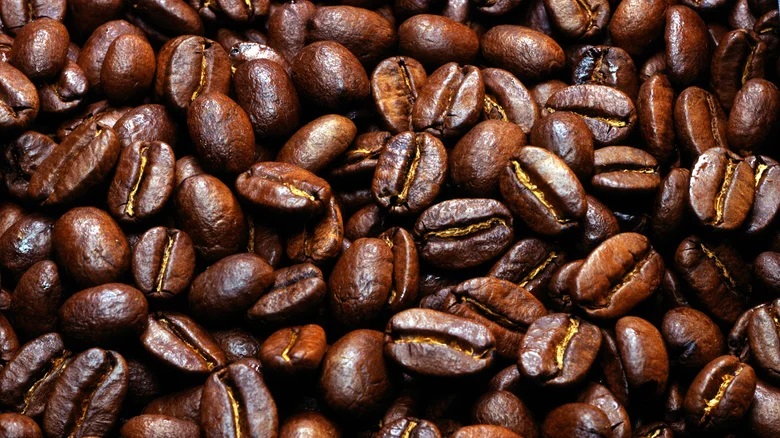
FEW COUNTRIES CAN COMPETE WITH BRAZIL`S COFFEE PRODUCTION.
Given Brazil’s enormous coffee exports, it should come as little surprise that other countries struggle to compete. Indeed, the second-place producer, Vietnam, exported 27.2 million of its 60-kilogram bags in 2023, followed by Indonesia with 11.9 million. Of course, Colombia, Ethiopia, Uganda, Honduras, and India also produce a fair amount annually, about 5-10 million each.
Colombia is actually one of the best-known coffee producers, famous for its high-quality arabica beans. These beans grow at relatively high altitudes and are sheltered by banana trees, giving them a flowery flavor once roasted.
Indonesia, on the other hand, found its claim to fame in its unique process of aging coffee beans, though this was initially a consequence of transporting the beans long distances. Aging low-acid beans results in a spicier taste, perfect for use in something like Starbucks’ Christmas Blend. Today, coffee beans designated for this process join the list of barrel-aged food products, as barrels provide a more controlled setting than a sea-bound ship.


Leave a comment